
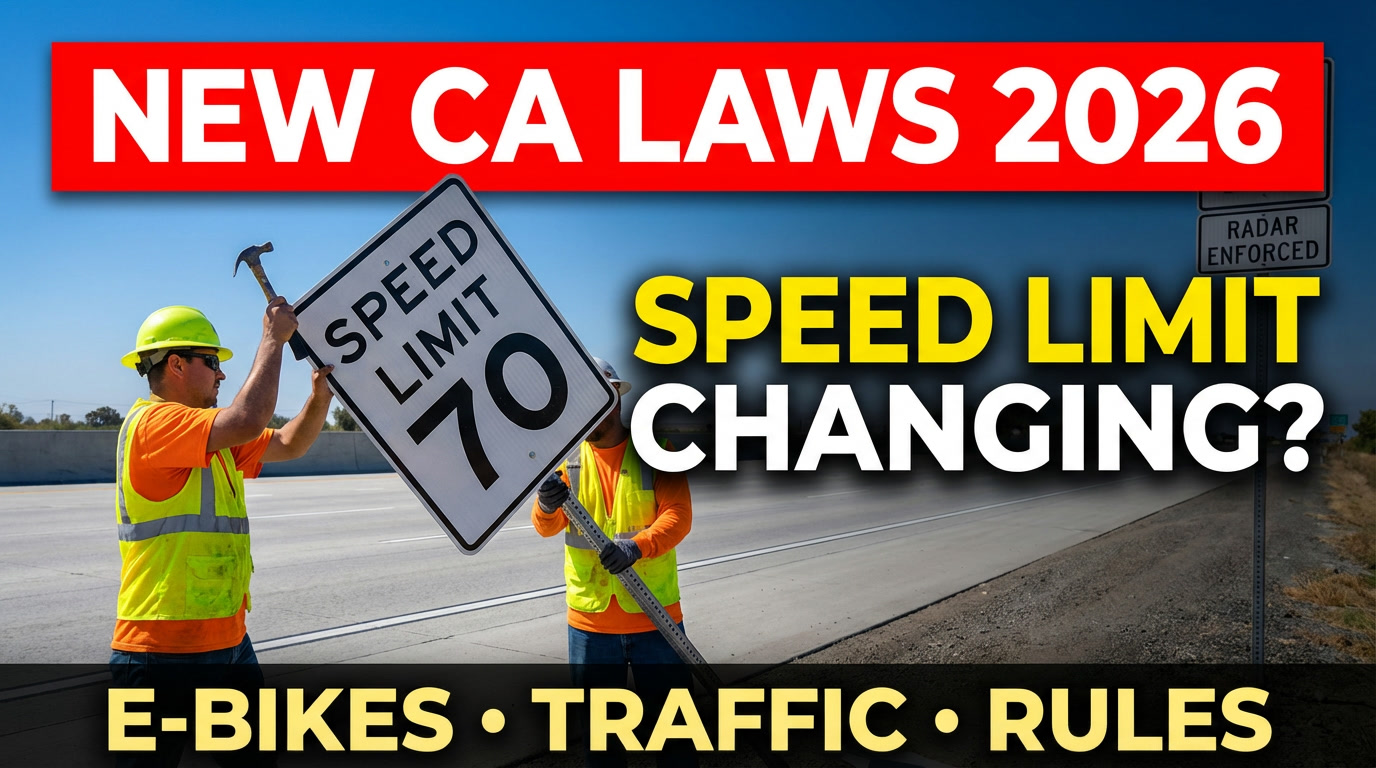
January always sneaks up with a quiet reset, but this time California drivers, riders, and pedestrians are getting more than just a fresh calendar. Tucked into the new year is a batch of public safety laws that will start reshaping how people move around the state — from e-bikes and school zones to work zones and burglary crackdowns. The California Highway Patrol is using the moment to flag what’s coming, and some of these changes will definitely be felt on the road.
Most of the laws were passed during the 2025 legislative session and signed by Gov. Gavin Newsom, with the bulk taking effect on January 1, 2026, unless otherwise specified. The common thread is safety, but the approach is broader than usual, blending traffic enforcement, technology controls, and pedestrian protections.
A tougher stance on burglary tools and tech-assisted crime

California lawmakers are zeroing in on a growing problem: high-tech burglary tools that make car and home break-ins faster and harder to trace.
Assembly Bill 486, authored by Assemblymember Tom Lackey, makes it a misdemeanor to possess key programming devices, key duplicating devices, or signal extenders if there is intent to commit burglary. These tools have become increasingly common in organized theft rings, particularly in vehicle-related crimes.
Under the new law, violators could face up to six months in county jail, a $1,000 fine, or both. Law enforcement officials have argued that existing laws didn’t adequately address possession of these devices before a crime occurred, limiting their ability to intervene early.

More details on California criminal statutes can be found through the state’s legislative portal at https://leginfo.legislature.ca.gov/.
E-bike safety rules tighten as usage explodes
Electric bicycles are no longer a niche mode of transport in California. They’re everywhere — commuting corridors, beach paths, suburban streets — and lawmakers are clearly reacting to that surge.
Assembly Bill 544, introduced by Assemblymember Laurie Davies, updates equipment requirements for e-bikes. Previously, a rear red reflector was only required when riding at night. Starting in 2026, e-bikes must have either a red reflector or a solid or flashing red light with a built-in reflector on the rear at all times while operating.

The bill also adds an education component for minors. If a minor receives a helmet violation while riding an e-bike, they’ll be required to complete an online e-bike safety and training program developed by the California Highway Patrol. The idea is less about punishment and more about behavior correction, especially as younger riders increasingly rely on e-bikes for school and social travel.
The CHP’s safety programs and bicycle guidance are outlined at https://www.chp.ca.gov/programs-services/programs/bicycle-safety.
Off-highway electric motorcycles finally get a legal definition
One of the more technical but important changes comes from Senate Bill 586, authored by Sen. Brian Jones. The law formally defines an “off-highway electric motorcycle,” often referred to as an eMoto.
To qualify, the vehicle must be designed primarily for off-highway use, powered by an electric motor that doesn’t require a motor number, have handlebars, a manufacturer-provided straddle seat, and two wheels. Crucially, it cannot have manufacturer-provided pedals.
Under the new law, these vehicles are classified as off-highway motor vehicles (OHVs). That means riders must follow existing OHV rules, including wearing a safety helmet and displaying a DMV-issued identification plate if the vehicle isn’t registered under the Vehicle Code.
This clarification closes a gray area that left riders, land managers, and law enforcement uncertain about how to treat electric dirt bikes and similar vehicles. DMV OHV registration rules are available at https://www.dmv.ca.gov/portal/vehicle-registration/off-highway-vehicles/.
School zones get slower, permanently
Pedestrian safety, especially around schools, is another major focus. Assembly Bill 382, introduced by Assemblymember Marc Berman, allows local governments to lower speed limits in school zones from 25 mph to 20 mph by ordinance or resolution through January 1, 2031.
After that date, the change becomes automatic. Once proper signage is posted, the speed limit will drop to 20 mph without requiring further local action.
Safety advocates have pushed for this change for years, pointing to data showing that even small reductions in vehicle speed dramatically reduce the severity of pedestrian injuries. For parents and school administrators, it’s a rare case where policy, infrastructure, and enforcement are finally aligning.
Speed enforcement enters a new phase in work zones
California is also experimenting with technology-driven enforcement in areas where workers are most vulnerable.
Assembly Bill 289, authored by Assemblymember Matt Haney, authorizes Caltrans to launch a State Highway Work Zone Speed Safety Pilot Program. The program would use fixed, mobile, or laser-based systems to detect speeding and capture clear images of a vehicle’s license plate.
While the pilot is limited in scope, it reflects a broader shift toward automated enforcement, particularly in high-risk areas. The goal is deterrence, not ticket volume, but civil liberties groups will be watching closely as implementation details emerge.
Caltrans work zone safety initiatives are detailed at https://dot.ca.gov/programs/work-zone-safety.
The “move over” rule expands beyond emergency vehicles
Most drivers know the “slow down and move over” law, but Assembly Bill 390 expands its reach.
Authored by Assemblymember Lori Wilson, the bill extends protections to include any highway maintenance or stationary vehicle using flashing hazard lights or warning devices, such as cones or road flares. Drivers must move into a lane not adjacent to the stopped vehicle. If that’s not possible, they’re required to slow down to a safe speed.
This change is aimed squarely at roadside workers and stranded motorists, groups that face significant risk from passing traffic. CHP officials say many drivers simply don’t realize the law applies beyond police cars and ambulances.
Speed limits can drop faster, with a warning window
Assembly Bill 1014, introduced by Assemblymember Chris Rogers, gives Caltrans new authority to reduce highway speed limits by up to 5 mph when safety conditions warrant it.
The law also includes a transition period: during the first 30 days after a speed reduction, only warning citations may be issued. It’s a nod to fairness, giving drivers time to adjust before enforcement ramps up.
Vehicles that don’t qualify as e-bikes face impoundment
Finally, Assembly Bill 875, authored by Assemblymember Al Muratsuchi, addresses a growing enforcement headache. The law allows police officers to impound a vehicle for at least 48 hours if it has fewer than four wheels but does not meet the legal definition of an e-bike.
This targets modified scooters, motorized devices, and DIY builds that operate in traffic without meeting safety or registration standards. For riders, the message is simple: if it’s not legally an e-bike, it doesn’t get e-bike privileges.
Why these laws matter heading into 2026
Taken together, these changes show California leaning harder into proactive safety — regulating technology before it becomes unmanageable and tightening rules where behavior hasn’t kept up with risk.
For drivers, cyclists, and pedestrians, the takeaway is preparation. These laws may not hit until January 2026, but enforcement agencies are already laying the groundwork. By this time next year, the rules of the road will look noticeably different.