
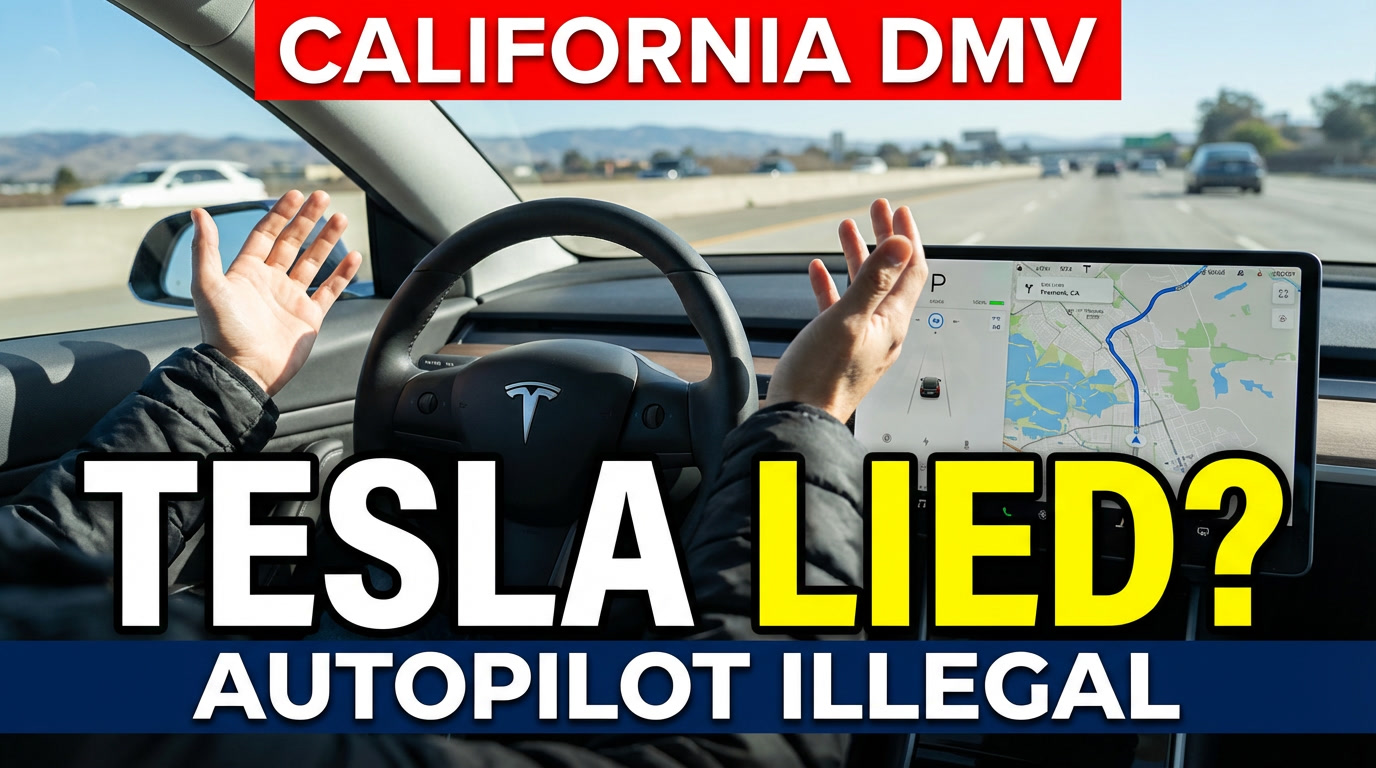
t finally happened in California, the state that once rolled out the red carpet for Silicon Valley hype. Tesla, the most valuable car company on the planet, has been formally called out by the California Department of Motor Vehicles for selling a dream that its cars still can’t legally deliver. The issue isn’t software bugs or hardware delays. It’s language. Words like “Autopilot” and “Full Self-Driving Capability,” according to regulators, crossed the line from optimism into deception.
At the center of the clash is a simple question with massive consequences: are Tesla buyers being sold driver assistance, or the promise of autonomous driving that doesn’t actually exist?
California DMV vs Tesla: how the fight reached a tipping point
On Tuesday, the California DMV confirmed what safety advocates have argued for years. Tesla violated state law by marketing its vehicles as if they were capable of autonomous driving, when in reality they still require a human driver to remain alert and in control at all times.
In the DMV’s own words, Tesla made “misleading use of the terms ‘Autopilot’ and ‘Full Self-Driving Capability’” in advertising campaigns dating back to May 2021. Those claims, regulators said, described features that Tesla vehicles “could not perform at the time of those announcements, and still cannot now.”
The investigation focused on how Tesla presented these features to consumers, not how advanced the software is in theory. California law draws a sharp distinction between driver-assistance systems and autonomous vehicles, and Tesla, according to the DMV, blurred that line in a way that could influence purchasing decisions.

This wasn’t a minor slap on the wrist. It was a formal determination that Tesla broke the rules in the most important car market in the United States. The DMV’s authority over licensing gives it teeth, and for a moment, Tesla was staring down a very real business disruption.
Sanctions softened, but the warning remains
Initially, an administrative law judge proposed a tough penalty: a 30-day suspension of both Tesla’s manufacturing license and its dealer license in California. That would have been unprecedented and hugely disruptive for a company that builds and sells vehicles at scale in the state.
But the DMV ultimately chose a less nuclear option.

The manufacturing suspension has been permanently canceled. The marketing sanction, however, has been temporarily suspended, with a catch. Tesla now has 60 days to clean up its advertising language or face consequences down the line.
DMV Director Steve Gordon made the agency’s position clear in a public statement, noting that Tesla could “take simple steps to stop this decision and permanently resolve this issue,” adding that other autonomous vehicle companies and traditional automakers have already managed to comply with California’s rules.
In regulatory terms, this is California saying: fix your words, or we escalate.
You can read the DMV’s regulatory framework around autonomous vehicles directly on the agency’s official site at https://www.dmv.ca.gov/portal/vehicle-industry-services/autonomous-vehicles/.
What Tesla actually sells versus what buyers hear
This dispute isn’t about whether Tesla’s software is impressive. It is. Tesla’s driver-assistance suite can change lanes, navigate highways, park, and respond to traffic controls in limited scenarios. The problem is the gap between technical reality and marketing language.
Despite years of branding, Tesla vehicles sold today are not autonomous. They sit firmly at Level 2 on the SAE scale, meaning they require constant human supervision. That’s a crucial legal distinction, and one regulators take seriously.
Here’s how the promises stack up against reality:
| Feature name | Marketing implication | Regulatory reality |
|---|---|---|
| Autopilot | Hands-free, self-driving assistance | Requires hands on wheel and full attention |
| Full Self-Driving Capability | Autonomous driving potential | Level 2 driver assistance only |
| Smart Summon | Car can drive itself to you | Driver must supervise and remain responsible |
Tesla does include disclaimers, but regulators argue that disclaimers don’t undo the impact of bold feature names and promotional videos.
The National Highway Traffic Safety Administration has echoed similar concerns in past investigations, which can be reviewed at https://www.nhtsa.gov/road-safety/driver-assistance-technologies.
From “Full Self-Driving” to “Full Self-Driving (Supervised)”
Under mounting pressure, Tesla has quietly begun tweaking its language. On its website, “Full Self-Driving Capability” has been rebranded as “Full Self-Driving (Supervised).” The added word matters legally, but critics note that it often appears in smaller text, far less prominent than the headline claim.
Tesla now states that its system “requires active driver supervision and does not make the vehicle autonomous.” That sentence satisfies regulators, but it sits uneasily alongside other phrases like “fully and intelligently performing precise driving maneuvers for you.”
This tension between marketing flair and legal compliance is exactly what landed Tesla in trouble. Regulators don’t just care what’s technically accurate in the fine print. They care about the overall impression left on a reasonable consumer.
Tesla’s own feature descriptions can be reviewed at https://www.tesla.com/support/autopilot.
When visuals undermine the warnings
Text isn’t the only problem. Videos matter, sometimes more than words.
The DMV flagged Tesla’s promotional videos as particularly concerning, especially demonstrations that appear to show vehicles operating without hands on the wheel or, in some cases, without a driver actively engaged. Features like Smart Summon, which allow a vehicle to move short distances without anyone inside, create a powerful visual narrative of autonomy, even when accompanied by disclaimers.
That contradiction is central to the DMV’s case. You can’t tell drivers to stay alert while showing a car behaving like it doesn’t need them.
These features are currently available in markets including the United States, Canada, China, Mexico, Puerto Rico, Australia, and New Zealand. Regulatory scrutiny, however, is most intense in California, where autonomous vehicle rules are among the strictest in the world.
Why California is drawing the line now
California has long positioned itself as both innovation-friendly and safety-focused. The state wants autonomous technology, but not at the cost of misleading consumers or risking public safety.
The DMV’s decision sends a broader signal to the entire industry. If Tesla, with its political influence and market dominance, isn’t exempt from truth-in-advertising laws, no one is.
This matters because consumer trust is fragile. Overstating capabilities doesn’t just affect buyers. It affects how drivers behave on the road. Studies have shown that drivers are more likely to disengage when they believe a system is more capable than it actually is, increasing crash risk.
That concern has already prompted federal investigations into Tesla crashes involving driver-assistance systems, details of which are available via https://www.nhtsa.gov/investigations.
Fact Check: did Tesla’s robotaxi launch “already happen”?
Some online claims suggest Tesla has already launched robotaxis and that the rollout was a “total disaster.” That characterization is misleading.
As of now, Tesla has not deployed a true robotaxi service operating without human supervision in California or elsewhere. CEO Elon Musk has repeatedly promised robotaxis “next year” for nearly a decade, but those promises remain unfulfilled.
Tesla has conducted limited demonstrations and pilot programs, but no fully autonomous commercial robotaxi network is operating under regulatory approval. Claims of a widespread robotaxi launch should be treated cautiously unless supported by filings with regulators such as the California Public Utilities Commission or the DMV.
What happens next for Tesla
Tesla has 60 days to revise its advertising language to comply with California law. If it does, the issue may quietly fade. If it doesn’t, the DMV retains the authority to revisit sanctions.
More broadly, this case underscores a turning point for the autonomous vehicle industry. The era of selling the future with bold names and loose promises is colliding with regulatory reality. Technology can move fast. Laws move slower. But when safety and consumer trust are involved, regulators eventually catch up.
For Tesla, the message from California is clear: build the future if you want, but don’t sell it before it exists.